Table of Contents
- Fresh Roasted Coffee vs Supermarket Beans: The Core Differences
- Why Coffee Roast Date Importance Decides What You Taste
- How to Store Coffee Beans for Freshness at Home
- Blends vs Single-Origin: Matching the Bean to Your Routine
- The Cost-Per-Cup Breakdown Most Shoppers Skip
- How to Tell Fresh Beans From Stale Ones Before You Buy
- Aromatics, Oils, and Why Mass-Produced Beans Taste Flatter
- Freshness, Shipping, and the Window After Delivery
- The Verdict: When Supermarket Beans Make Sense
- Frequently Asked Questions
Last Updated: September 15, 2026
Fresh Roasted Coffee vs Supermarket Beans: The Core Differences
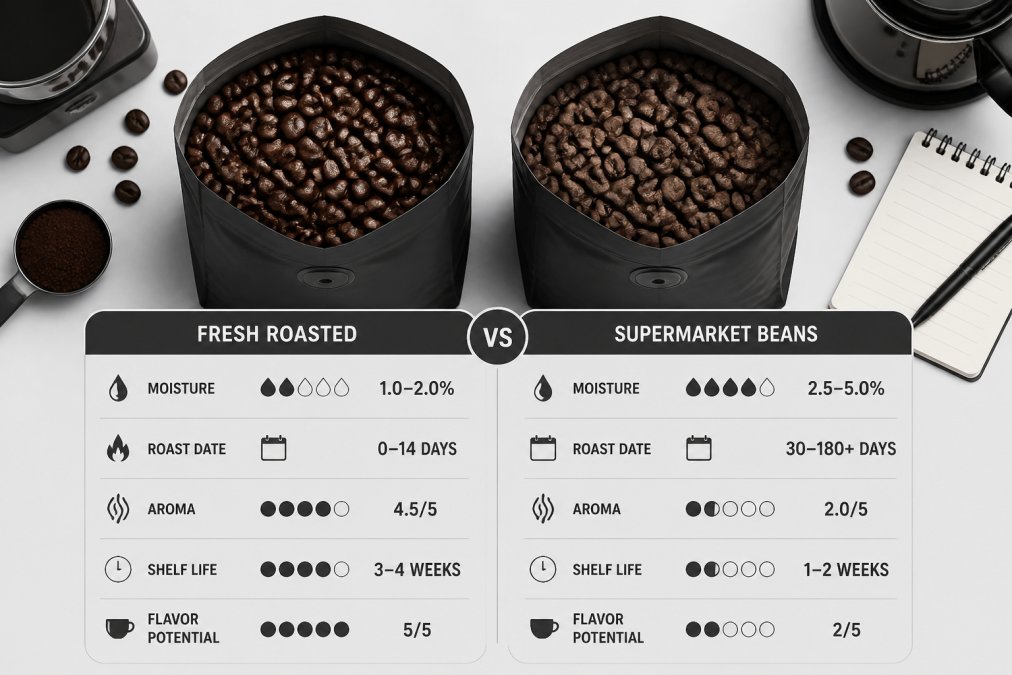
Fresh roasted coffee vs supermarket beans comes down to one variable: the roast date. Coffee loses its best qualities within days of roasting, and grocery shelves often hold beans roasted months earlier.
At Promise Roast Co., we roast in small batches only after an order is placed, keeping the gap between roast and brew measured in days.

Why Coffee Roast Date Importance Decides What You Taste
Coffee roast date importance is simple: the roast date tells you how much life is left in the bean. Roasting triggers degassing, and that CO2 protects flavor compounds until it dissipates, after which oxidation flattens aroma and mutes acidity and body.
“Best before” dates mislead: they’re a shelf-life estimate, not a freshness guarantee.
Use beans within two to four weeks of the roast date for peak flavor; expect noticeable staleness after about six weeks (Changes in sensory quality characteristics of coffee during storage).

How to Store Coffee Beans for Freshness at Home
How to store coffee beans for freshness comes down to four enemies: oxygen, moisture, heat, and light.
Keep beans in an opaque, airtight container at room temperature, away from heat and light; buy only what you’ll finish in two to three weeks; skip the freezer for daily-use beans; and grind immediately before brewing (Effect of Temperature and Storage on Coffee’s Volatile Compound Profile and Sensory…).
If you freeze, portion into single-use airtight bags and grind from frozen.
Blends vs Single-Origin: Matching the Bean to Your Routine
Blends are built for consistency and balance; single origins showcase one region’s flavor notes. Neither is better, they serve different mornings.
Promise Roast Co.’s House Blend is a smooth, clean medium roast with nutty sweetness, sweet chocolate, mild citrus, and a bright finish. The Breakfast Blend is even smoother and more balanced, built for drip, pour-over, or French press.
The single origins deliver: Colombia brings dried orange, berry, and chocolate; Guatemala pairs dark chocolate and butterscotch with bright fruit; and Bali Blue is the boldest, a medium-dark roast with dark chocolate, molasses, brown sugar, and a long, syrupy finish.

|
Coffee |
Roast Level |
Tasting Notes |
Best For |
|---|---|---|---|
|
Medium |
Nutty, sweet chocolate, mild citrus |
Everyday consistency |
|
|
Breakfast Blend |
Medium |
Smooth, balanced, morning-friendly |
Drip and pour-over routines |
|
Medium |
Dried orange, berry, chocolate |
Bright, fruit-forward cups |
|
|
Guatemala |
Medium |
Dark chocolate, bright fruit, butterscotch |
Balanced sweetness |
|
Medium-Dark |
Dark chocolate, molasses, brown sugar |
Bold, syrupy body |
Every bag is $21.99, roasted after your order is placed and processed within one to five days.
The Cost-Per-Cup Breakdown Most Shoppers Skip
The cost-per-cup breakdown is where supermarket math stops working: a cheaper bag only wins if you drink it while it’s fresh, and the last third of a bulk bag often goes stale, raising the real cost of every good cup.
Divide the bag price by the cups it makes, then ask how many you’ll drink inside the fresh window.
How to Tell Fresh Beans From Stale Ones Before You Buy
Aromatics, Oils, and Why Mass-Produced Beans Taste Flatter
Freshness, Shipping, and the Window After Delivery
The Verdict: When Supermarket Beans Make Sense
Frequently Asked Questions
Are fresh roasted coffee beans actually better than supermarket beans?
Fresh roasted coffee beans usually taste better because they still hold the gases and oils that carry aroma and flavor. Supermarket bags often sit for months past their roast date, so those compounds fade and the cup turns flat. The gap shows up most in aroma, sweetness, and acidity. If you buy from a roaster that ships within days of roasting, like Promise Roast Co.’s 1-5 day processing window, you taste the difference in the first pour.
How long do coffee beans stay fresh after roasting?
Most beans hit peak flavor 4 to 14 days after roasting, once degassing slows. After about 3 to 4 weeks, oxidation and moisture loss start flattening the flavor notes. Whole beans hold up longer than pre-ground coffee because less surface area is exposed to air. For the best cup, buy amounts you’ll finish within a month and check the roast date on every bag before you brew.
How should you store coffee beans to maintain peak freshness?
Keep beans in an airtight, opaque container at room temperature, away from light, heat, and moisture. Skip the fridge, since temperature swings pull condensation into the beans. The freezer works only if you seal beans in a vacuum bag and thaw them fully before grinding. Buy smaller amounts more often so you’re always brewing within the degassing window, and grind right before you brew to protect the oils.