Table of Contents
- What You’ll Need Before You Brew Flavored Coffee Beans
- How Flavoring Is Applied to Coffee Beans
- Choosing a Brewing Method for Flavored Coffee Beans
- How to Clean Your Grinder After Flavored Coffee
- Mixing Flavored and Unflavored Coffee Beans
- Storing Flavored Coffee Beans for Peak Freshness
- Flavor Pairing Ideas and Recipes
- Health and Dietary Considerations
- Frequently Asked Questions
Last Updated: September 17, 2026
What You’ll Need Before You Brew Flavored Coffee Beans
Learning how to use flavored coffee beans starts with a simple truth: the beans are only half the equation. The rest comes down to your gear, your grind, and how you treat your equipment afterward.
Before you brew, gather these basics:
- A burr grinder you can clean easily
- A brewing method you’re comfortable with (drip, pour-over, French press, or espresso)
- Hot water just off the boil, around 200°F
- A small brush for grinder cleanup
- An airtight container for storage
How Flavoring Is Applied to Coffee Beans
Flavoring is applied after roasting, not during it. The beans cool first, then get tumbled with flavor oils or extracts until the coating spreads evenly. Heat would burn off most flavor compounds, which is why timing matters.
Natural Extracts vs. Artificial Flavoring
Natural extracts come from real sources: vanilla beans, cocoa, fruit, spices. Artificial flavoring is built in a lab to mimic those tastes. Both can taste good; the difference shows up in aroma and shelf life.
Choosing a Brewing Method for Flavored Coffee Beans
Drip, pour-over, and French press are the safest choices for flavored beans. They’re easy to clean and don’t trap oils the way espresso machines can.
Drip, Pour-Over, and French Press
- Drip: Use a medium grind. The paper filter catches most of the oil, so cleanup is minimal.
- Pour-over: Same grind, more control over flavor intensity. Great if you want a lighter cup.
- French press: Coarse grind. The metal mesh lets more oil through, which means a richer cup but more residue to rinse.
Water temperature matters across all three. Aim for 200°F. Hotter water pulls out bitterness. Cooler water leaves the flavor behind.
Espresso Machines and Super-Automatic Machines
This is where flavored beans get risky. Espresso machines push flavor oils at high pressure into places you can’t easily reach.
- Use a separate, inexpensive grinder just for flavored beans
- Run a plain bean “purge” shot after each flavored session
- Descale and backflush on a tighter schedule than usual
Skipping the purge shot is the most common mistake with flavored beans and espresso. The next plain coffee you brew will taste like whatever flavor was left in the machine. That flavor migration can linger for several shots.
How to Clean Your Grinder After Flavored Coffee
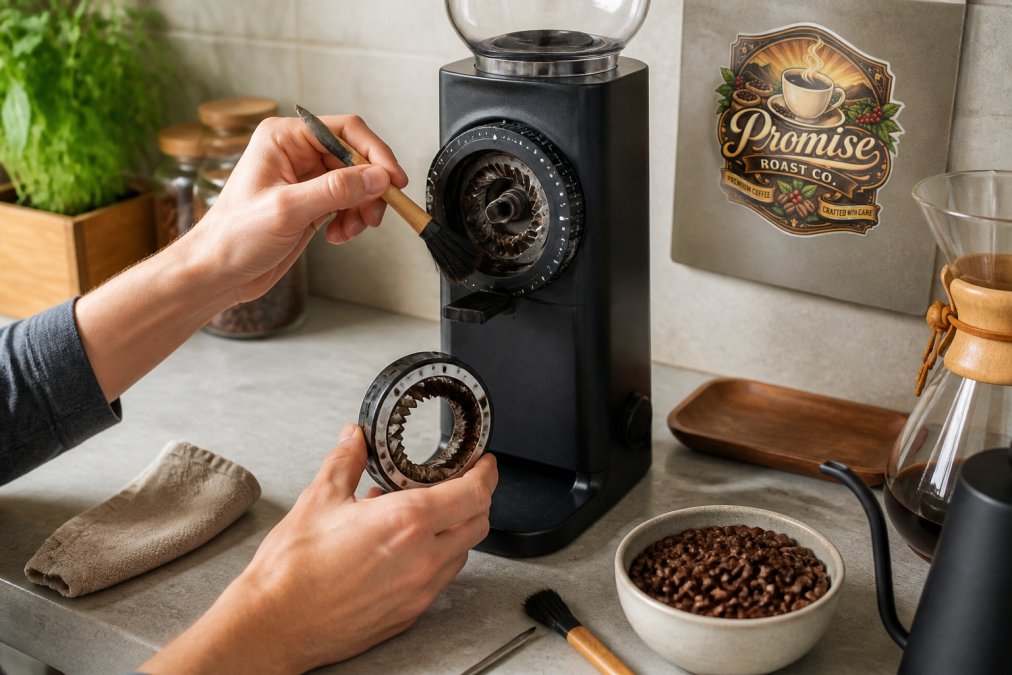
Clean your grinder after every flavored batch, not every few weeks. Flavor oils coat the burrs and the chute, and left alone that coating transfers into your next batch of plain beans. A dry brush alone only moves residue around, so here is the full protocol: a quick daily routine and a monthly deep clean.
Quick Clean (After Every Flavored Batch)
- Unplug the grinder and empty the hopper completely. Do not leave flavored beans sitting in the hopper overnight.
- Remove the top burr if your model allows it, most conical burr grinders release with a quarter turn.
- Brush the burrs with a stiff, dry brush, working from the center outward, then brush the burr carrier threads.
- Wipe the chute and grounds bin with a dry cloth. A damp cloth pushes oil deeper into seams.
- Run a small handful of plain, unflavored beans through to push out loose residue, then toss those grounds.
- Reassemble and store the grinder with the hopper empty.
Deep Clean (Monthly, or After Heavy Flavored Use)
A dry brush cannot dissolve oil that has polymerized onto the burrs, the layer that turns rancid and taints every future batch. For a real reset:
- Disassemble as far as your manual allows. Remove the hopper, top burr, and any removable chute cover. Photograph each step so reassembly is easy.
- Dry-brush first. Knock off loose grounds before introducing any moisture.
- Use grinder cleaning tablets. These food-safe, grain-based tablets absorb oils as they pass through the burrs. Run the dose your manual specifies, then discard the expelled powder. This is the single most effective step for oil removal.
- For stubborn residue on removable parts only, wash with warm water and a drop of mild dish soap, then dry completely before reinstalling. Never introduce water into the motor housing or the fixed burr assembly.
- Wipe the burr chamber with a dry microfiber cloth. If residue remains, repeat the tablet cycle rather than reaching for solvents.
- Reassemble and season. Run about 15-20 grams of plain beans through and discard to push out tablet dust and re-coat the burrs with coffee oil.
What Not to Do
- Do not use rice. It is harder than burr steel and can chip or dull the cutting edges.
- Do not use water on the motor side. Even a damp cloth near the motor housing risks corrosion.
- Do not skip the seasoning run. The first shot or brew after a deep clean will taste flat or slightly metallic without it.
Keep a dedicated “flavor brush” and never use it on your espresso gear. Cross-contamination between flavored and plain setups is the fastest way to ruin a good burr grinder. Label the brush with tape so no one grabs it by mistake.
If you grind flavored beans in the same grinder you use for espresso, budget for a deep clean every two weeks instead of monthly. Espresso grind settings run the beans through slower and hotter, which deposits more oil per gram than a coarse drip grind.
When to Replace the Burrs
Burrs are a wear part, not a lifetime component. Most manufacturers rate flat burrs for roughly 500-1,000 pounds of coffee and conical burrs for longer. Flavored beans do not wear burrs faster on their own, but the extra cleaning cycles add up. If your grinder produces inconsistent particle sizes even after a deep clean, the burrs are the likely culprit, not the flavored beans.
Mixing Flavored and Unflavored Coffee Beans
You can blend flavored and unflavored beans, but do it in the cup, not the grinder. Grinding them together coats your burrs with oil and throws off the flavor balance of both.
- In the cup: Brew separately, then combine. You control the ratio every time.
- In the bag: Mix whole beans right before brewing. Grind them together only if you plan to clean the grinder right after.
- In the hopper: Avoid this. Flavor migration will season every future batch.
Storing Flavored Coffee Beans for Peak Freshness
Store flavored coffee beans in an airtight container, away from light and heat. The flavor coating is sensitive to air and moisture. A loose bag clip won’t cut it.
Keep these rules in mind:
- Use an opaque, airtight container. Glass or ceramic works well.
- Store at room temperature, not the fridge. Condensation ruins the coating.
- Keep beans away from strong-smelling foods. Bean porosity means they absorb nearby odors.
- Buy in smaller amounts. Smaller batches stay fresher than bulk bags.
Flavor Pairing Ideas and Recipes
Match the flavor to the brew method and the moment. A vanilla bean shines in a French press. A hazelnut roast works beautifully in a drip machine. Here are pairings worth trying.
- Vanilla + oat milk latte: Brew strong, add steamed oat milk, skip the syrup. The bean does the work.
- Caramel + cold brew: Steep coarse-ground flavored beans overnight for a smooth, sweet finish.
- Cinnamon + pour-over: A light roast with cinnamon notes pairs well with a splash of cream.
- Mocha + French press: Cocoa-flavored beans plus a dusting of cocoa powder on top.
Health and Dietary Considerations
Most flavored coffee beans are fine for daily drinking, but the label matters more than the flavor name. The coating adds negligible calories, fractions of a gram per serving. The real questions are what is in that coating, whether it contains allergens, and whether the flavor name hides added sugar or dairy.
What Is Actually in the Coating
Flavor coatings fall into three buckets:
- Flavor oils and extracts: The base carrier. These are typically food-grade oils (often a neutral carrier like sunflower or fractionated coconut oil) blended with natural or artificial flavor compounds.
- Solvents and carriers: Small amounts of food-grade propylene glycol or ethanol are common in liquid flavorings. They evaporate or burn off in the roast-and-coat process, but trace amounts remain on the bean.
- Sweeteners and powders: Some flavored roasts, especially dessert-style flavors like caramel, mocha, or s’mores, include powdered sugar, cocoa powder, or milk-derived ingredients in the coating to boost aroma.
That third bucket is where dietary issues live. A bean labeled “vanilla” is usually just flavor oil; one labeled “vanilla caramel cream” may contain dairy or added sugar.
Allergens to Watch For
Flavor names do not always signal allergens, but the ingredient list will. Common ones to check:
- Milk and dairy: Look for “whey,” “milk powder,” “nonfat dry milk,” “butter” or “cream” in the coating ingredients. Common in caramel, mocha, and dessert flavors.
- Tree nuts and peanuts: Hazelnut, almond, and praline flavors may use real nut derivatives or may use artificial flavoring only. The ingredient list is the only reliable signal.
- Soy: Soy lecithin is a common emulsifier in flavor coatings.
- Sulfites: Less common in coffee, but some dried-fruit flavors (cherry, apricot) can carry them.
Sugar, Calories, and Caffeine
- Added sugars: Plain flavor oils contain none. Sweetened coatings can add a small amount, usually under a gram per brewed cup, but it varies by roaster and flavor. If you are tracking sugar for medical reasons, ask the roaster for the coating spec.
- Calories: A black cup of flavored coffee is essentially calorie-free, same as plain coffee. Calories come from what you add, milk, cream, syrups.
- Caffeine: Flavoring does not change caffeine content. A flavored bean has the same caffeine as its unflavored counterpart from the same roast. Darker roasts lose a small amount of caffeine by mass during roasting, but the flavoring step has no effect.
- Acidity: Flavored beans are not more acidic than plain beans, roast level drives acidity, not the coating. If you have reflux, a dark roast, flavored or not, is usually gentler than a light roast.
Artificial vs. Natural Flavoring and Health
There is no evidence that food-grade artificial flavoring is less safe than natural flavoring at the amounts used on coffee, the regulatory distinction is about sourcing, not risk. If you prefer natural extracts, look for “natural flavor” on the ingredient list, but do not assume that means additive-free; natural flavoring can still be carried in propylene glycol or ethanol.
A Practical Label Checklist
Before you buy a flavored bag, scan for these four things:
- Ingredient statement, not just the flavor name on the front.
- Allergen callouts, “Contains: milk, soy” or similar.
- Added sugar, listed in the ingredients, not just the nutrition panel.
- Roaster contact, a roaster that publishes ingredient specs is easier to vet than one that does not.
Flavored coffee is not a health food, but it is also not a hidden-calorie trap. The coating contributes almost nothing to your daily intake. The dietary risks are allergen exposure and added sugar in sweetened dessert-style coatings, both of which are visible on the label if you know where to look.
Frequently Asked Questions
Do flavored coffee beans damage coffee grinders?
Flavor oils and artificial flavoring can leave residue buildup on grinder burrs, which may affect grind consistency and transfer flavors to future batches. Regular cleaning with grinder cleaning tablets or a brush helps prevent this. Using a dedicated grinder for flavored beans or cleaning thoroughly after each use protects your equipment and keeps unflavored coffee tasting pure.
Can you mix flavored and unflavored coffee beans?
Yes, mixing flavored and unflavored coffee beans is a common way to adjust flavor intensity. Start with a 1:3 ratio of flavored to unflavored beans, then tweak to taste. Keep in mind that flavor migration can occur during storage, so store them separately if you want to preserve the original profile of your unflavored beans.
How do you store flavored coffee beans to keep them fresh?
Store flavored coffee beans in an airtight container away from light, heat, and moisture. A cool, dark cupboard works well. Avoid the refrigerator because condensation can degrade the beans. For peak freshness, use within two to three weeks of opening, and consider buying smaller quantities if you drink coffee slowly. Promise Roast Co. roasts to order, so beans arrive fresh and are best enjoyed soon after delivery.
Are flavored coffee beans good for you?
Flavored coffee beans are generally safe for most people, but some artificial flavorings and added syrups may contain sugar or other additives. If you have dietary restrictions, check the ingredient list. Natural extracts tend to have fewer additives. Enjoy flavored coffee in moderation as part of a balanced routine, and consult a healthcare provider if you have specific health concerns.
Flavored coffee beans reward a little extra care. Keep a clean grinder, store your beans right, and match the flavor to your brew method. Promise Roast Co. roasts every order in small batches and ships it fresh, so the flavor you taste is the flavor the roaster intended. Shop Coffee and find a roast that fits your morning ritual.