Table of Contents
- Why Proper Storage Matters for Coffee Freshness
- Step 1: Choose the Best Coffee Storage Containers
- Step 2: Control Your Storage Environment
- Step 3: Decide Between Whole Bean and Ground Coffee Storage
- Step 4: How to Tell If Coffee Beans Are Fresh
- Understanding Coffee Shelf Life After Roasting
- Common Mistakes to Avoid
- Conclusion
- Frequently Asked Questions
Last Updated: September 1, 2026
Why Proper Storage Matters for Coffee Freshness
The moment coffee is roasted, oxidation begins. Exposure to oxygen, heat, light, and moisture degrades the volatile compounds that give coffee its flavor and aroma. Proper storage preserves the investment you’ve made in quality beans.
At Promise Roast Co., we roast every order individually to ensure peak freshness arrives at your door. But what happens after that first cup matters just as much as the roast itself. Without proper storage, even the finest small-batch coffee loses its character within days. The difference between stale and fresh coffee comes down to controlling your environment.
Most people store coffee like cereal, on the counter in the original bag, exposed to light and air. Within a week, the coffee tastes flat and the aroma fades. This isn’t because the coffee was bad, it’s because the storage was. Keeping coffee fresh is straightforward once you understand what you’re protecting against.
Step 1: Choose the Best Coffee Storage Containers
The container you choose is your first line of defense against oxidation and moisture. An airtight container is non-negotiable, when oxygen reaches the coffee’s surface, it triggers chemical reactions that degrade flavor compounds.
Airtight vs. One-Way Degassing Valves
A one-way degassing valve lets carbon dioxide escape without letting oxygen in. Coffee releases CO2 for several days after roasting. If that gas has nowhere to go, pressure can force the seal open, letting oxygen in. A degassing valve solves this by allowing gas out while keeping air out.
If you’re storing coffee within the first week of roasting, a container with a one-way valve is ideal. If you’re storing coffee that’s already been open for a few days, or keeping beans for weeks, a simple airtight seal works fine because most CO2 has already escaped.
Promise Roast Co. ships coffee in bags designed with degassing valves. Once you transfer beans to a long-term storage container, choose based on how long you plan to keep them.
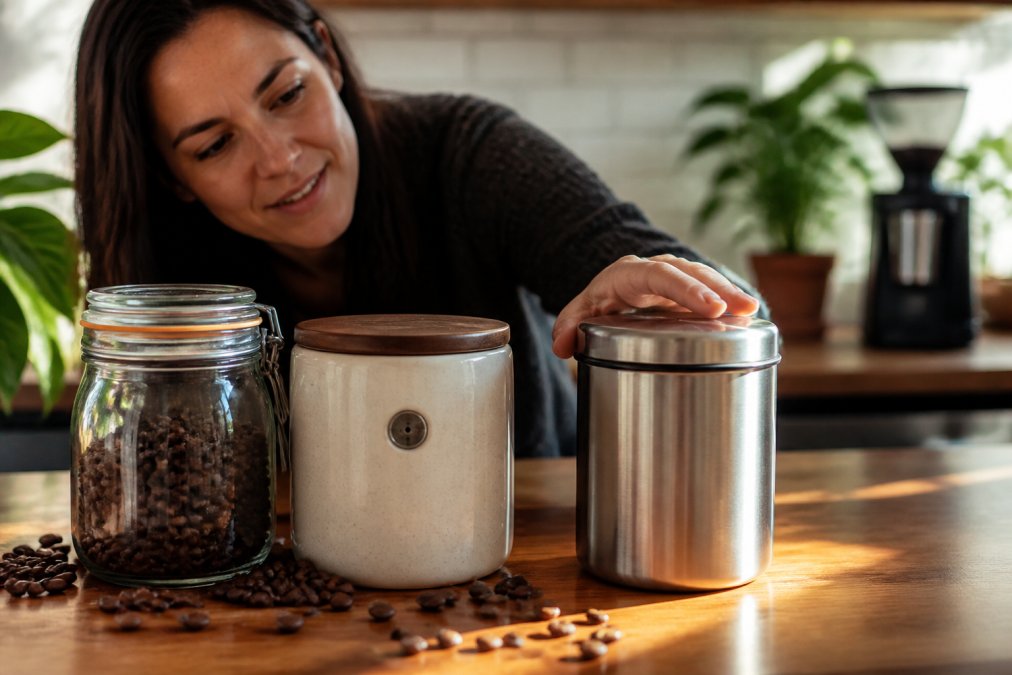
Material Comparison: Glass, Ceramic, and Stainless Steel
Glass offers visibility but is transparent, light penetrates it and accelerates degradation. Store glass containers in a dark cabinet or use tinted glass.
Ceramic is opaque, protecting from light, and insulates reasonably well. It’s durable and attractive but heavier and harder to seal perfectly.
Stainless steel is the most practical choice. It blocks all light, insulates against temperature changes, doesn’t absorb odors or oils, and seals tightly. The only drawback is you can’t see how much coffee remains without opening the lid.
For long-term storage, stainless steel wins. For everyday use where you want visibility, ceramic with a tight seal is better.
Step 2: Control Your Storage Environment
The container protects your coffee, but the environment around it matters equally. Temperature stability, humidity control, and light exclusion determine how long your beans stay fresh.
Coffee stays freshest between 60°F and 70°F, with humidity below 60% (peer-reviewed research). Most homes fluctuate more than this. A kitchen near a stove experiences temperature swings. A bathroom has high humidity. These fluctuations cause the air inside your container to expand and contract, pulling in fresh oxygen each time temperature drops.
Store your coffee in a cool, dry closet or pantry instead of the kitchen. A bedroom closet is often ideal, away from cooking heat, usually darker, and maintaining more stable temperatures. If you must store coffee in the kitchen, choose the coolest, darkest spot available.
Humidity is particularly important in humid climates. Coffee is hygroscopic and absorbs moisture from the air. Excess moisture accelerates degradation and can promote mold growth. If your environment is humid, add a silica gel packet to your storage container.
Heat accelerates every chemical reaction that makes coffee stale. A 10-degree temperature increase roughly doubles the rate of degradation. Light, particularly UV light, breaks down flavor compounds and aroma. Moisture causes coffee to swell and become more porous, increasing surface area for faster oxidation.
If you open your container and see condensation on the lid, your storage environment is too humid. Move the container to a drier location or add silica gel packets.
Step 3: Decide Between Whole Bean and Ground Coffee Storage
Whole beans stay fresh significantly longer than ground coffee. When you grind beans, you increase surface area by roughly 1,000 times (peer-reviewed research). More surface area means faster oxidation.
Whole beans in an airtight container at room temperature stay fresh for 2-4 weeks (peer-reviewed research). Ground coffee in the same conditions stays fresh for 3-5 days. If you’re committed to peak freshness, invest in a grinder and grind immediately before brewing.
If you must buy ground coffee, buy smaller quantities and use it within days. Promise Roast Co. offers whole bean, ground, and convenient pods that maintain freshness through individual packaging.
Step 4: How to Tell If Coffee Beans Are Fresh
Freshness matters, but how do you know when your coffee has crossed from fresh to stale? Visual and aroma indicators tell the story.
Visual and Aroma Indicators of Staleness
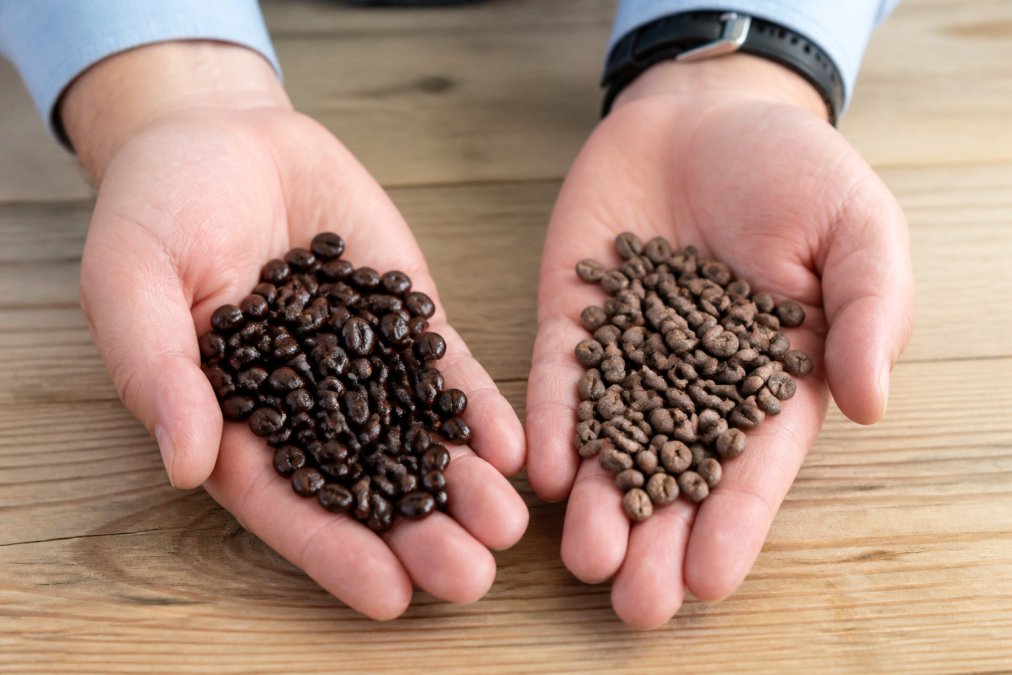
Fresh coffee beans have a subtle sheen from natural oils on the surface. As beans age, they lose this sheen and become dull. After 3-4 weeks, the difference is obvious.
Aroma is the most reliable indicator. Fresh coffee smells vibrant and complex. As coffee ages, the aroma becomes muted. After a few weeks, the smell is faint and one-dimensional.
The bloom test reveals freshness too. When you pour hot water over fresh grounds, CO2 escapes and creates a visible bloom. Stale coffee produces little to no bloom. A weak or absent bloom is a clear sign the coffee has lost freshness.
Understanding Coffee Shelf Life After Roasting
Coffee doesn’t have an expiration date. It gets progressively less flavorful over time.
Optimal Consumption Timeline
The first 24-48 hours after roasting, coffee is still releasing CO2 and not yet at peak flavor.
Days 3-14 after roasting is the sweet spot. CO2 has mostly escaped, flavors have developed, and the coffee hasn’t started to noticeably degrade. This is when you get the full complexity of the roast. Most specialty roasters, including Promise Roast Co., time shipping so your coffee arrives in this window.
Days 15-30 after roasting, the coffee is still quite good, though subtle flavor notes begin to fade. After 30 days, degradation accelerates. After 6-8 weeks, most coffee is noticeably stale.
This timeline assumes proper storage. Coffee stored in poor conditions degrades 2-3 times faster.
Freezing Coffee Beans for Long-Term Storage
Freezing extends coffee freshness significantly, but only if done correctly. The misconception is that freezing damages coffee, temperature fluctuations damage coffee.
Place your airtight container in the freezer immediately after opening it and leave it there. Don’t remove it, let it warm to room temperature, then put it back. Every temperature cycle pulls moisture from the air into the container through condensation.
Frozen coffee in a sealed container stays relatively fresh for 3-4 months. When ready to use, remove the container from the freezer and let it come to room temperature while still sealed. Once it reaches room temperature, grind and brew immediately.
Many coffee enthusiasts freeze half their purchase immediately after arrival, then keep the other half in the pantry for current use. This strategy extends the overall freshness window of a single order.
Common Mistakes to Avoid
Storing in the original bag with the seal rolled down. The original bag has a degassing valve designed for transit, not long-term storage. Transfer to an airtight container immediately.
Keeping coffee on the counter for visibility. You’re exposing it to light, heat, and temperature fluctuations. Move it to a dark cabinet.
Using the refrigerator. Refrigerators are humid and create condensation inside your container. Room temperature storage beats the refrigerator.
Buying too much at once. Even with perfect storage, coffee degrades over time. Buy smaller quantities more frequently.
Grinding in advance. Pre-grinding costs freshness dramatically. Grind immediately before brewing.
Not checking humidity. If you live in a humid climate and aren’t using silica gel, your coffee is absorbing moisture. Silica packets make a measurable difference.
Storing in clear containers. Light penetrates glass. Keep glass containers in a completely dark cabinet, or use opaque stainless steel.
Conclusion
Keeping your coffee fresh requires attention to four variables: container quality, temperature stability, light exclusion, and humidity control. Get these right, and your coffee stays vibrant for weeks.
The freshest coffee comes from small-batch roasters who roast to order. Promise Roast Co. roasts your coffee after you order, not before. But freshness depends on what you do next. An airtight stainless steel container in a cool, dark pantry, away from heat and moisture, preserves the flavor Promise Roast Co. worked to create. Shop Coffee and experience the difference that proper storage, and truly fresh roasting, can make.
Frequently Asked Questions
How long does coffee stay fresh after roasting?
Peak freshness typically lasts 2-4 weeks after the roast date. Whole beans maintain their flavor profile and aroma longer than ground coffee. After 4 weeks, coffee doesn’t become unsafe to drink, but volatile compounds that create rich flavor degrade, resulting in a flatter taste. Check the roast date on your bag and consume accordingly.
What are the signs that coffee beans are stale?
Stale coffee loses its vibrant appearance and develops a dull, gray surface. The aroma becomes muted or absent, fresh beans release a strong, pleasant scent when opened. During brewing, stale coffee may fail to bloom properly, and the resulting cup tastes flat, bitter, or hollow. If beans smell musty or off, discard them.
Should you store coffee in the freezer or pantry?
For short-term storage (under 4 weeks), a cool, dark pantry in an airtight container works best. Freezing extends shelf life to 3-4 months if done properly, seal beans in an airtight, opaque container to prevent freezer burn and condensation. Thaw completely before opening to avoid moisture absorption. Avoid the refrigerator, which exposes beans to temperature fluctuations and humidity.
What is the best container to store coffee in?
Choose an airtight, opaque container made of glass, ceramic, or stainless steel. One-way degassing valves allow carbon dioxide to escape without letting oxygen in, preserving freshness. Avoid clear containers that expose beans to UV light, and skip plastic bags or containers that absorb odors. The container should seal tightly to block moisture and oxygen.