Table of Contents
- AeroPress vs French Press: Core Differences at a Glance
- Brewing Method Comparison: Pressure vs. Immersion
- Flavor Profile, Body, and Coffee Grind Size for Immersion Brewing
- AeroPress vs French Press Grit: Filtration and Sediment
- Is AeroPress Coffee Real Espresso? Understanding Brew Pressure
- Ease of Use, Cleanup, and Maintenance
- Portability, Durability, and Brew Capacity
- Which Brewer Wins for Your Coffee Routine
- Frequently Asked Questions
Last Updated: September 23, 2026
AeroPress vs French Press: Core Differences at a Glance
When you’re choosing between brewing methods, the decision comes down to what matters most: speed, flavor, or ritual. The aeropress vs french press comparison reveals two fundamentally different philosophies. One uses pressure to extract quickly and cleanly. The other relies on full-immersion steeping to pull out every nuance. Understanding these differences helps you pick the brewer that fits your morning routine and taste preferences.
The choice often depends less on which brewer is objectively “better” and more on what you value in your cup. Some mornings demand speed. Other mornings demand richness. This guide walks you through the real differences so you can decide which one belongs on your counter.
The core tension: AeroPress brews fast and clean using paper filters and air pressure. French Press brews slower and fuller using immersion and a metal mesh filter. Your choice depends on whether you prioritize convenience or coffee oils and body.
Brewing Method Comparison: Pressure vs. Immersion
Here’s where the two diverge most dramatically. The AeroPress uses air pressure and paper filtration to force hot water through coffee grounds in 1.5 to 3 minutes. The French Press uses full-immersion steeping, where grounds sit in hot water for 4 minutes, then you press a plunger down to separate the liquid from the sediment.
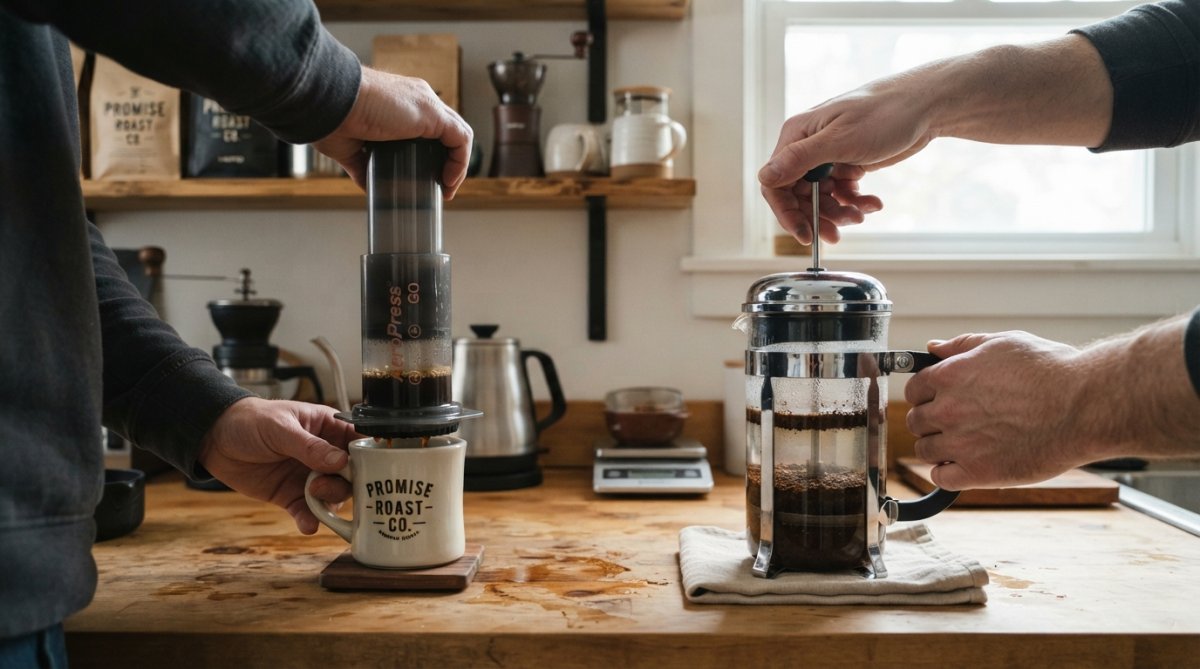
The pressure approach means you’re forcing extraction. The immersion approach means you’re letting extraction happen naturally. This difference cascades through everything else: cleanup, flavor, sediment, and how the coffee tastes in your cup.
The French Press is simpler mechanically. You add grounds, pour hot water, wait, and press. No moving parts beyond the plunger. The AeroPress requires more attention, you’re managing water temperature, pressure intensity, and timing more actively. Neither is objectively harder, but they feel different in your hands.
Water temperature matters equally for both methods. Most coffee tastes best with water between 195-205°F. If you’re using boiling water straight from the kettle, let it cool for 30 seconds before pouring.
Flavor Profile, Body, and Coffee Grind Size for Immersion Brewing
This is where personal preference becomes the deciding factor, and where grind size plays a critical role in success. The French Press produces a heavier body with more coffee oils and tannins in the cup. Those oils create mouthfeel and richness. The metal mesh filter in a French Press lets them through intentionally, that’s part of the design.
The AeroPress produces a cleaner, brighter cup. Paper filters trap those oils, resulting in clarity and acidity that some coffee lovers chase and others actively avoid. If you prefer single-origin beans where you can taste the origin’s characteristics clearly, the AeroPress highlights them. If you prefer blends that feel smooth and full, the French Press delivers that.
Grind Size Specificity: The Difference That Matters Most
Grind size matters differently for each method, and getting it wrong is the fastest way to ruin a brew. For French Press immersion brewing, you need a coarse grind, think sea salt or peppercorn size, roughly 0.75 to 1 millimeter. Finer grounds over-extract during the 4-minute steeping and make the cup bitter and muddy. Coarse grounds extract more slowly and evenly, pulling out sweetness and body without the harsh tannins that come from prolonged contact.
For AeroPress, you can use a medium-fine grind, think granulated sugar or fine sand, roughly 0.5 to 0.75 millimeter, because the shorter contact time (1.5 to 3 minutes) and pressure extraction work differently. The pressure forces water through grounds faster, so finer particles don’t have time to over-extract. You’re also actively controlling the brew by pressing, which gives you real-time feedback.
Troubleshooting by Taste:
If your French Press tastes bitter or harsh, your grind is too fine. Move to a coarser setting on your burr grinder. If it tastes sour or weak, your grind is too coarse. Move finer. If your AeroPress tastes sour or under-extracted, try a finer grind or extend your brew time by 15 seconds. If it tastes bitter, use a coarser grind or reduce brew time.
The grind size specificity is one reason French Press feels more forgiving to beginners in theory, you can’t accidentally over-extract as easily with coarse grounds, but it’s also why many people fail with a French Press: they use pre-ground coffee or a grind size meant for drip coffee, which is too fine. The AeroPress is more forgiving because the pressure and active pressing give you control mid-brew.
Using a fine grind in a French Press is the most common mistake. It leads to over-extraction, bitterness, and a cup that tastes muddy. Stick with coarse grounds and you’ll see immediate improvement. If you don’t have a burr grinder, invest in one, blade grinders produce inconsistent particle sizes that make both methods unreliable.
AeroPress vs French Press Grit: Filtration and Sediment
Here’s the practical difference that shows up in your mouth. The AeroPress uses paper micro-filters that trap nearly all sediment. You get zero grit in your cup, the coffee tastes clean and clear. Those paper filters also trap coffee oils, which is why the cup feels lighter on the palate.
The French Press uses a metal mesh filter. It’s effective at separating grounds from liquid, but fine particles slip through. Many people describe this as “grit” or “silt” at the bottom of the cup. Some coffee enthusiasts love this, it’s part of the full-bodied character. Others find it unpleasant and prefer the clarity of paper filtration.
If sediment bothers you, the AeroPress wins decisively. If you don’t mind it and actually enjoy the fuller mouthfeel it contributes, the French Press delivers exactly what you want. Neither is wrong; they’re different philosophies about what belongs in your coffee.
The bypass brewing technique, where some water passes through the filter without contacting grounds, happens more readily in French Press because the mesh is less efficient than paper. This means some of your brew tastes slightly weaker than the rest. It’s subtle, but it’s there.
Is AeroPress Coffee Real Espresso? Understanding Brew Pressure
This question comes up often, and the answer matters for expectations. The AeroPress produces espresso-style coffee, not true espresso. Real espresso requires 9+ bars of pressure. The AeroPress generates roughly 0.75 bars of pressure, enough to produce a concentrated, full-flavored cup, but not enough for the thick crema and intense body of true espresso.
What you get from an AeroPress is closer to a concentrated manual brew. It tastes richer and more intense than a standard pour-over or French Press because of the pressure and the shorter extraction time.
Ease of Use, Cleanup, and Maintenance
The AeroPress wins decisively on cleanup. The paper filters trap all the grounds, so you pop them out, rinse the chamber, and you’re done, takes 60 seconds. No residual coffee smell, no grounds hiding in corners. The plastic and rubber components are durable and simple to maintain. The entire device can go in the dishwasher if you prefer, though hand-rinsing extends the life of the rubber seal.
Maintenance and Longevity: Extending Device Life
Descaling and Mineral Buildup
Store your AeroPress with the plunger removed and the chamber dry. Store your French Press with the carafe empty and the filter assembly dry. This prevents rubber degradation from prolonged moisture exposure and keeps both devices ready to brew.
Portability, Durability, and Brew Capacity
The AeroPress Original weighs about 4 ounces and fits in a backpack easily. The AeroPress Go adds a mug that doubles as a carrying case, making it genuinely portable for travel or camping. You can brew a single 8-ounce cup anywhere you have hot water. The plastic construction is durable, these brewers survive drops and rough handling.
Choose AeroPress if you travel, camp, or want the fastest cleanup. Choose French Press if you brew for multiple people, prioritize richness over clarity, and don’t mind a heavier morning ritual.
Which Brewer Wins for Your Coffee Routine
Pick AeroPress if: You value speed (under 3 minutes), prefer clean, bright coffee, travel frequently, want minimal cleanup, or brew only for yourself. The paper filters and pressure extraction give you clarity that highlights single-origin beans beautifully. The brightness lets each origin’s character come through.
Frequently Asked Questions
Does AeroPress make better coffee than French press?
Neither is objectively better, it depends on your taste preferences. AeroPress uses paper filters and pressure to produce a clean, bright cup with clarity and less acidity, while French press uses a metal mesh filter for full-immersion brewing, resulting in a heavier body and more coffee oils in your cup. If you prefer crisp, clean flavors, AeroPress wins. If you enjoy bold, rich coffee with tannins and oils, French press delivers more. Both extract coffee effectively; they just taste different.
Which coffee maker is easier to clean: AeroPress or French press?
AeroPress is significantly easier to clean. After brewing, you simply press the puck of grounds and paper filter into the trash, rinse the chamber, and you’re done, usually under 30 seconds. French press requires more work: you must carefully dispose of wet grounds from the metal mesh filter, rinse thoroughly to remove sediment and oils, and often soak it to prevent buildup. For busy mornings, AeroPress’s cleanup advantage is substantial.
What coffee grind size should I use for immersion brewing with a French press?
Use a coarse grind for French press immersion brewing, similar to sea salt or peppercorns. Coarse grounds slow extraction during the 4-minute steeping time and prevent over-extraction, which causes bitterness and sediment. If your grind is too fine, you’ll get grit in your cup and a muddy, over-extracted flavor. Consistency matters: uneven grinds lead to bypass brewing, where some particles extract too fast and others too slow, creating an unbalanced cup.
Can you make espresso-style coffee with an AeroPress?
AeroPress produces espresso-style coffee in appearance and strength, but not true espresso. Real espresso requires 9+ bars of pressure; AeroPress delivers only 0.75 bars from manual pressing. However, AeroPress creates a concentrated, full-bodied brew that works well for lattes, cappuccinos, and other espresso drinks. Many coffee lovers use AeroPress as an espresso substitute because the result is close enough for milk-based drinks and requires no electricity or expensive equipment.
Your coffee matters more than your brewer. Whether you choose AeroPress or French Press, start with fresh beans roasted specifically for your brewing method. Promise Roast Co. roasts small-batch coffee to order, ensuring peak freshness arrives within 1-5 days. Shop our single-origin and blend selections, each crafted to highlight the qualities your chosen brewer brings out best.