Table of Contents
- The Chemistry Behind Roasting: Maillard Reaction and Caramelization
- How Roasting to Order Improves Flavor at the Peak Window
- The Coffee Degassing Process: Why Timing Matters for Your Brew
- The Impact of Oxidation on Coffee Flavor and Shelf Life
- How to Tell If Coffee Beans Are Fresh: A Practical Checklist
- Small-Batch vs. Large-Batch Roasting: Control, Consistency, and Flavor
- Home Roasting vs. Professional Roasting to Order: What Actually Works
- Frequently Asked Questions
Last Updated: September 10, 2026
The Chemistry Behind Roasting: Maillard Reaction and Caramelization
Does roasting to order improve flavor? Yes, and the reason starts with chemistry. Roasting to order means beans are roasted after you buy them, not weeks or months before. Freshly roasted coffee tastes better because the roast itself creates flavor, and those flavor compounds begin fading almost immediately after the roast cools.
Two reactions do most of the work. The Maillard reaction is a browning process between amino acids and sugars that builds the nutty, toasty, malty notes in coffee. Caramelization follows, breaking down sugars into sweeter, rounder compounds as bean temperature climbs past roughly 340°F (PubMed). Both depend on heat application, and both produce volatile compounds that carry aroma and flavor profile.
Here’s the catch most guides skip: those compounds are fragile. The same heat that creates them also leaves them exposed to oxygen the moment roasting ends.
How Roasting to Order Improves Flavor at the Peak Window
Roasting to order improves flavor by delivering beans inside their peak window, the stretch when aromatics are at full strength and the coffee is still releasing gas. That window is narrow, and it opens the day the roast finishes.
Coffee at the grocery shelf has usually been roasted weeks earlier. By the time it reaches your kitchen, much of the aroma has already escaped the bag. Ordering from a roaster that fires each batch after your order places you near the start of that window instead of the end of it.
At Promise Roast Co., every order is roasted in small batches after it’s placed, with 1-5 day processing built around that timing. The difference isn’t marketing; it’s a shorter gap between first crack and your brew method.
The Coffee Degassing Process: Why Timing Matters for Your Brew
The coffee degassing process is the release of carbon dioxide trapped inside beans during roasting. A freshly roasted bean can hold its own volume in CO2, and that gas escapes slowly over days (peer-reviewed research). Until most of it is gone, the gas pushes water away from the grounds, producing an uneven extraction and a cup that tastes flat, sharp, or oddly muted.
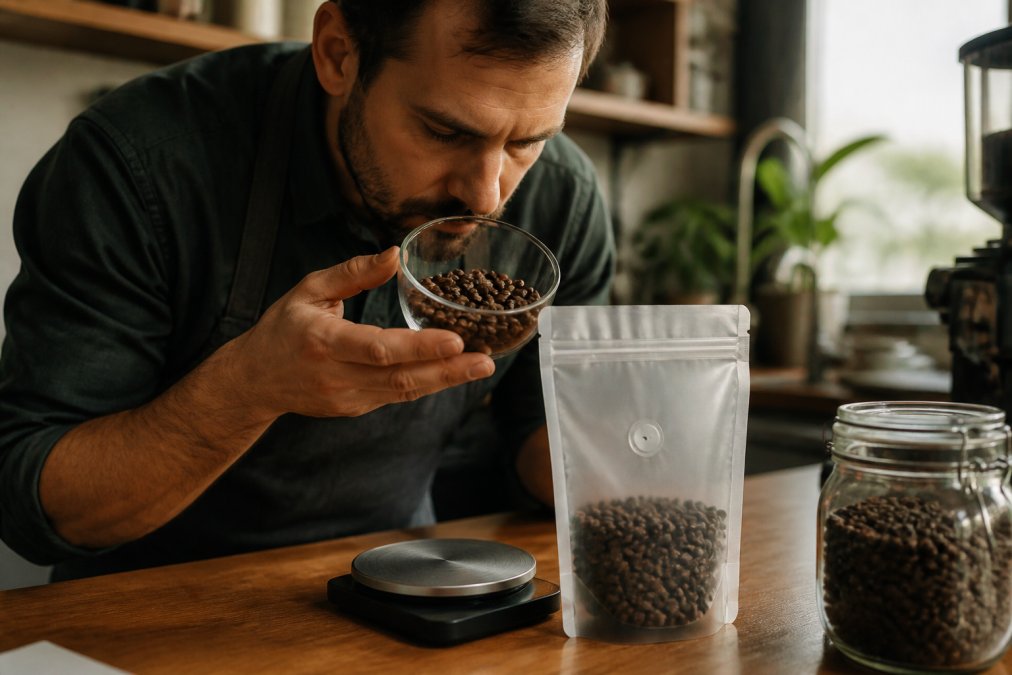
This is the degassing window, and it’s the detail most freshness guides leave out. The roast date on the bag tells you when the clock started, but the right day to brew depends on three variables:
- Roast level. Dark roasts degas faster because the bean structure is more porous. Light roasts hold CO2 longer and often need more rest.
- Brew method. Espresso is the most sensitive. CO2 interferes with the pressure-driven puck, so most practitioners rest espresso beans 5-10 days after roast (sca.coffee). Pour-over and drip generally peak around 3-7 days. Immersion methods like French press are more forgiving and can taste good as early as 2-3 days.
- Grind size. Finer grinds expose more surface area and release CO2 faster, which is why a bean that tastes flat as espresso can still bloom well in a pour-over.
A simple test: put a spoonful of grounds in a cup, pour hot water over them, and watch the bloom. A vigorous, bubbling rise means the beans are still actively degassing and may need another day or two. A weak or flat bloom usually means the window has passed.
A one-way valve bag helps by letting CO2 out while keeping oxygen in check, but it can’t stop the clock. The valve manages pressure, not flavor. Once the peak window closes, the same volatile compounds that made the coffee worth roasting fresh begin fading, and no storage trick brings them back.
That resting period is also why roasting to order beats buying off a shelf. A bag roasted weeks ago has already spent its best days in transit, and by the time it reaches your kitchen the degassing window has closed.
The Impact of Oxidation on Coffee Flavor and Shelf Life
Oxidation is the slow reaction between coffee oils and oxygen, and it’s the main reason shelf life matters more than most people think. Once beans are exposed to air, oils on the surface begin turning rancid, and the bright acidity and sweetness that defined the cup start flattening. The change is gradual, which is why stale coffee rarely tastes spoiled. It just tastes dull.
Three factors control how fast oxidation moves:
- Surface area. Grinding accelerates oxidation sharply. A whole bean has a fraction of the exposed surface of a ground particle, which is why pre-ground coffee can lose most of its character within days while whole beans hold their flavor profile for weeks.
- Roast level. Dark roasts carry more oil on the surface and oxidize faster. Light roasts are denser and more resistant, though they still fade.
- Storage conditions. Heat, light, and moisture all speed the reaction. An airtight, opaque container kept in a cool, dark cabinet slows oxidation but never stops it.
A common pattern among specialty coffee roasters is to print a roast date and suggest a best-by window of roughly 2-6 weeks for whole beans and 1-2 weeks for ground. Those numbers aren’t arbitrary. They track the point where oxidation has stripped enough volatile compounds that the cup no longer reflects the roaster’s intent.
This is where roasting to order changes the math. A bag roasted weeks before it reaches a shelf has already spent part of its shelf life in a warehouse and a truck. Ordering from a roaster that fires each batch after your order means the oxidation clock starts when the bag ships, not when the beans were roasted for inventory. You get the full window instead of the remainder.
The practical takeaway: buy in amounts you’ll finish within a few weeks, and treat the roast date as the real expiration date. A bag with no roast date tells you nothing about how much freshness is left, and no amount of careful storage can recover flavor that oxidation has already taken.
How to Tell If Coffee Beans Are Fresh: A Practical Checklist
Knowing how to tell if coffee beans are fresh comes down to a few physical signals you can check in seconds. Use this checklist before you brew:
- Roast date printed on the bag, not just a “best by” date
- One-way valve present on the packaging
- Beans feel slightly oily or matte depending on roast level, never dried out
- A audible crackle or bloom when hot water hits the grounds
- Strong aroma when you open the bag, not a flat or papery smell
- Beans are whole, not pre-ground, unless you’ll finish them fast
If two or more of these are missing, the coffee is likely past its best. A roast-to-order bag will usually hit every box.
Small-Batch vs. Large-Batch Roasting: Control, Consistency, and Flavor
Small-batch roasting gives the roaster tighter control over the roast curve, the temperature-and-time path each batch follows. With less mass in the drum, heat application is more even, and the roaster can adjust development time in real time.
Large-batch roasting favors volume and consistency across huge runs, but individual batches move through first crack and second crack less predictably. The result is a broader flavor range within a single production day.
| Factor | Small-Batch | Large-Batch |
|---|---|---|
| Batch control | High, adjusted per roast | Standardized across runs |
| Roast curve precision | Tight | Broader tolerance |
| Flavor consistency | Varies slightly batch to batch | Highly uniform |
| Best for | Specialty coffee, peak freshness | Supermarket volume |
Neither approach is wrong. They serve different goals, and the trade-off is control versus scale.
Home Roasting vs. Professional Roasting to Order: What Actually Works
Home roasting appeals to tinkerers, and it can produce excellent cups. The catch is repeatability: without a roast curve and reliable convection or conduction heat, matching a great batch a second time is hard.
Professional roasting to order solves that by pairing equipment with experience. A roaster tracks thermal energy, logs development time, and can hit the same flavor profile on demand, then ship it inside the degassing window.
That’s the honest split. Home roasting is a hobby with real rewards; professional roasting to order is how you get consistent specialty coffee without the trial and error. For most drinkers who want peak freshness without the learning curve, ordering from a small-batch roaster is the practical choice.
Frequently Asked Questions
Does roasting to order make a noticeable difference in taste?
Yes, for most coffee drinkers it does. When you roast to order, the beans reach you within days of roasting rather than weeks or months. That timing matters because volatile compounds and coffee oils begin fading soon after roasting. A freshly roasted batch delivers more aroma, sweetness, and body, while older beans taste flat and papery. The difference is easiest to notice in a light or medium roast brewed as pour-over, where delicate fruit and floral notes are most exposed.
What is the coffee degassing process and how long does it take?
The coffee degassing process is the release of carbon dioxide trapped inside beans during roasting. Most of that gas escapes in the first 24 to 48 hours, which is why baristas often wait a few days before brewing. Peak flavor usually lands somewhere between 4 and 14 days after the roast date, depending on the roast level. Darker roasts degas faster, while lighter roasts can take longer. Brewing too soon can cause uneven extraction and a sour or gassy cup.
How do I tell if coffee beans are fresh?
Start with the roast date, not the best-by date. A roast date printed within the last two weeks is a strong signal. Fresh beans also feel slightly oily or matte rather than dry and cracked, smell sweet and aromatic when you open the bag, and release a visible puff of gas when you pour hot water over them. If the beans smell like cardboard or sawdust, oxidation has already done its work.
How long does coffee stay fresh after roasting?
Whole beans hold peak flavor for roughly two to four weeks after the roast date when stored in an airtight, opaque container away from heat and light. Ground coffee fades much faster, often within a week, because more surface area is exposed to oxygen. Freezing whole beans in a sealed bag can extend freshness to several months. After the peak window, the coffee is still safe to drink, but the aroma, sweetness, and body will have dropped noticeably.
Coffee flavor peaks in a narrow window, and most bags on a shelf have already missed it. Promise Roast Co. roasts every order in small batches after you place it, with 1-5 day processing and free U.S. shipping, so your beans arrive near the start of their peak rather than the end. Explore single-origin options like Bali Blue, Brazil Santos, Colombia, and Costa Rica, then shop coffee and taste the difference freshness makes.